I think
The future belongs not to those who answer the fastest, but to those who continue to ask questions worth answering.
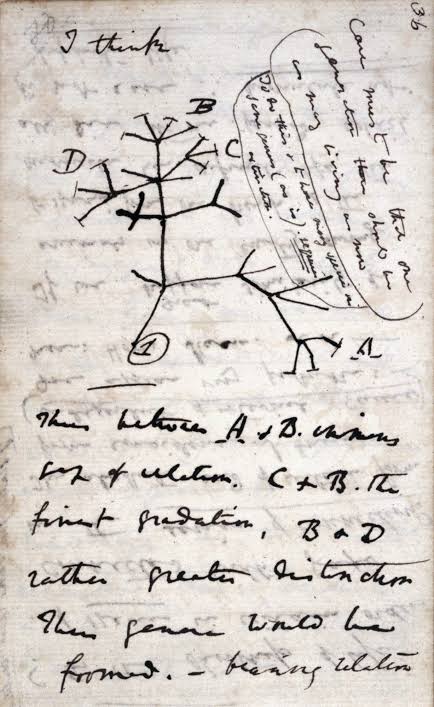
In one of his notebooks, Charles Darwin drew a very rough tree, with notes alongside it that reveal he was searching for numerical balance between extinct and living species. Above it, he wrote two words: “I think”.
What these words signify is that Darwin didn’t begin with an answer. There was curiosity preceding these lines. He began with a question, an observation, and the curiosity to explore an idea that he had not yet fully understood.
At the time, he simply followed observations and questions that interested him, not knowing they would eventually culminate in his theory of evolution.
The current era of AI has changed the way we view knowledge. We are losing the willingness to think without immediately knowing, to question without expecting an instant answer, and to explore an idea simply because it fascinates us.
We no longer feel the need to sit with a question, struggle with an unfamiliar concept, or follow a thought simply to discover where it leads. We have started to value the speed of finding an answer more than the experience of arriving at one.
Yet, curiosity has never been about how quickly we can know something; it is about how deeply we are willing to wonder about it. Some questions don’t have instant answers. At first, they may seem insignificant, but it takes curiosity to entertain an idea before truly knowing whether it will lead anywhere. And perhaps that is exactly what Darwin captured in those two words.
The danger is not that AI will make us less intelligent, but that we might become less curious, less persistent in our quest for answers. When every uncertainty can be resolved instantly, we may forget that some of humanity’s greatest discoveries began with nothing more than a thought that someone was inquisitive enough to pursue.
As we move into a future where the distinction between humans and machines becomes increasingly hard to discern, it is our greatest responsibility to preserve the one quality that drives us to go beyond what is already known — our curiosity. After all, the future belongs not to those who answer the fastest but to those who continue to ask questions worth answering.
Comments